

As we all know, AI is no longer optional for marketers. Most content teams now bring in AI at multiple stages in their process – researching, drafting, editing. Sounds like progress, right?
But there’s a big difference between using AI for discrete tasks and actually integrating it into how you work. And while most marketers use AI in some form, only 21% have integrated it extensively into their workflows.
The highest-performing teams aren’t just using AI more often. They’re using it as a strategic partner: challenging the same idea multiple times; identifying the right approach for their audience; refining strategy through back-and-forth dialogue.
This is known as the “Co-Creative Design Framework,” a model that describes how humans and AI work together through iterative exchanges rather than one-directional tasks. Co-creation means dynamic interaction for deeper, stronger thinking – not just responding to prompts and moving on.
Beyond Human-in-the-Loop: What Co-Creation Actually Means
If you’re in tech, you’re probably familiar with the term human-in-the-loop, which refers to a system where agentic AI handles tasks, then a human steps in to review at key checkpoints.
Co-creation is more than quality control.
In sequential, human-in-the-loop workflows, you’re essentially checking AI’s work. In co-creative workflows, you’re working with AI to strengthen your own thinking through the entire process.
Here’s what that distinction looks like in practice:
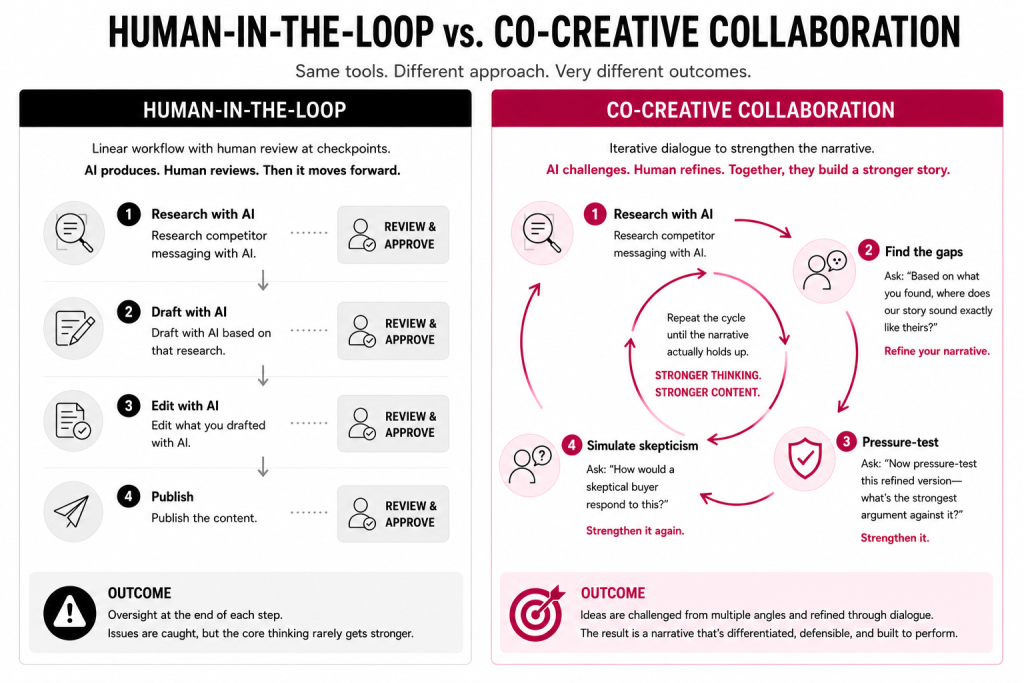
See the difference?
Human-in-the-loop or sequential use treats each AI interaction as a task to complete and validate. Co-creation treats each interaction as part of an evolving conversation about the same strategic challenge. Think of it as having a coworker who never gets tired of talking about the same idea.
The Co-Creative Design Framework calls this “interaction dynamics” – basically, the way your relationship with AI evolves as you work together on the same creative product. You’re not just checking AI’s results. You’re having a real exchange where each round strengthens the idea itself.
Why Co-Created Content Performs Better
The difference shows up in results. Even though AI-produced content has taken over the internet, the top results found by Google or ChatGPT or Perplexity are still much more likely to have been written by humans.
But we know that most content teams are using AI somewhere in their process. So the difference isn’t necessarily human versus AI. It’s human strategic thinking strengthened through co-creative dialogue versus AI generator/human validator.
Maybe that’s why less than a quarter of marketers say AI improves content quality. Using it as a tool gives you faster drafts. Human-in-the-loop adds a layer of quality control. Co-creation, on the other hand, sharpens strategy. And that’s the real benefit.
The brands whose content outperforms aren’t using AI to write more. They’re using it to think better – and that’s what makes the difference.
Why You Need Editorial Expertise, Not Just Better Prompts
The shift from using AI as a stepwise tool to treating it as a co-creative collaborator isn’t really about your AI skills. It’s about recalibrating your editorial judgement.
You need strategic clarity to co-create effectively.
Co-creation means working with AI on something specific – your narrative, your argument, your differentiation. But you can’t iteratively refine a brand story that isn’t clear enough to test. That’s something you have to know, concretely, in the real world, before you bring it to AI.
You need to know what questions make your ideas stronger.
“Make this better” is a weak prompt. Sure, it might provide some refinement, but it’s not changing the underlying structure. “Where does this claim need more evidence to be convincing?” starts a conversation that will make your argument more defensible. These questions aren’t easy – but they’re critical.
You need to recognize what AI reveals – and know how to fix it.
When you run a narrative through an AI persona and it finds gaps in your story, then it’s time to revisit your position. Then pressure-test it again to see if you’ve made it stronger or just shifted the problem around. That’s editorial judgment, not prompt engineering.
The Version A Advantage
These days, everyone has access to the same AI tools. Not everyone has the strategic clarity and editorial expertise to unlock the co-creative advantage. That’s the difference between publishing more content and publishing more effective content.
At Version A, we know that building a strong co-creative relationship with AI isn’t much different than building a strong co-creative relationship with your writers and editors. The best colleagues know when – and how – to bring out stronger arguments, deeper insights, and more engaging narratives. It’s what we’ve been doing all along.
AI doesn’t replace strategic thinking. But when it becomes a co-creator, helping you refine your brand through real dialogue, it shows you whether your thinking is strategic enough.
Are you ready to move from basic AI use to workflow-integrated co-creation? Version A has the editorial expertise to help you make that shift.